



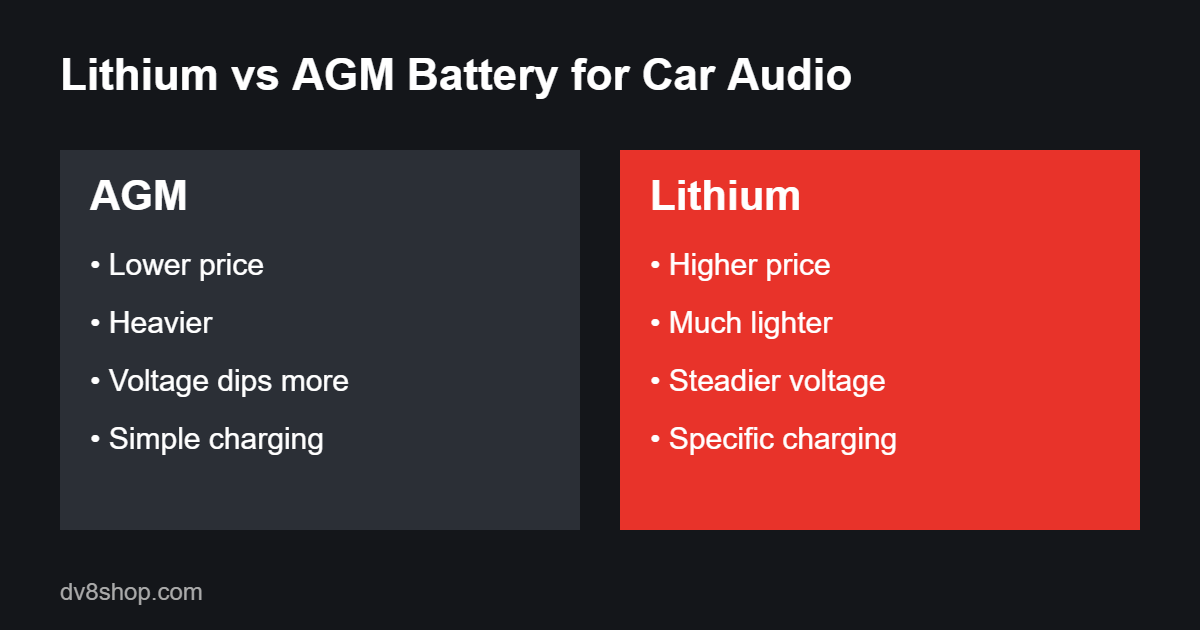
Lithium vs AGM Battery for Car Audio: Which One Should You Buy?
Lithium vs AGM battery for car audio: compare weight, voltage under load, lifespan and cost, and find out which one fits your system.
19 categories
20 brands
DV8
17 products / 2 categories
SoundQubed
125 products / 6 categories
Beyma
29 products / 2 categories
FI Car Audio
31 products
Every FI Car Audio product, together on one page.
Resilient Sounds
21 products / 2 categories
Stetsom
26 products
Every Stetsom product, together on one page.
Prodigy Audio
15 products / 2 categories
PRV Audio
189 products / 8 categories
Gately
50 products / 3 categories
Ruthless
17 products / 2 categories
Ill Customz
37 products / 2 categories
Limitless
17 products / 4 categories
BrandX
108 products / 5 categories
Galeforce
9 products / 2 categories
DS18
1,173 products / 15 categories
Nagy
11 products
Every Nagy product, together on one page.
Elite Sounds
7 products / 2 categories
Custom Speaker Pods
998 products / 4 categories
Voodoo Bikeworks
61 products / 9 categories

Car audio terminology can feel like another language, especially if you are getting into SPL competition. Here are the basic terms you will hear most, explained in plain English.
Hertz – The hertz (symbol: Hz) is the unit of frequency in the International System of Units (SI) and is defined as one cycle per second.
Bandwidth – the span of frequencies your car audio system can play most efficiently.
Your bandwidth is typically your peak frequency plus or minus 5Hz. Run a sweep on a meter to get exact data. Example: Peak is 39Hz, Bandwidth = 34-44Hz
Musical Average When playing music during the run, the average of the total score maintained through the run is the final score.
Example: You begin your run at 156 db and as the run continues it continues to lower due to loss of power over the course of the run. By the end of the run your score is now a 154 db. Your musical average final score would be about 155 db.

Peak Frequency The frequency, measured in hertz that your vehicle generates the highest decibel level.
Example: Your vehicle does a 145 DB at 39 hertz but only does a 144 or lower at other frequencies. 39 hertz would be your peak frequency.
Peak HoldPlaying tones otherwise known as burping is usually scored based on Peak Hold. This is the level at which your vehicle played the loudest and is used to determine your overall score.
Run A run is your complete attempt, from start to finish to put up a score on a meter. Some organizations allow re-runs, where you are allowed a second or third attempt on the meter.
Scratch/DQ If your vehicle is in violation of any rules or regulations or if you break a rule during your run/attempt your final score may result in a scratch or Disqualification.
SPL Meter Device used in SPL Competition. The microphone can be placed in various areas of the vehicle depending on format. It measures the sound pressure level of the vehicle. It is usually placed on the windshield near the dash referred to as a Legal or Dash Score. Other common locations are the headrest of the seat, in the kick which is the front corner of the floorboard near the door.
Sweep A series of tones played in a vast range to determine the peak frequency of the vehicle. A sweep will play a tone beginning at a low frequency and continue to higher frequencies.
Bandwidth is the span of frequencies your system plays most efficiently. It is typically your peak frequency plus or minus 5 Hz. Read more in our understanding bandwidth guide.
A sweep plays a series of tones from low to high frequency so you can find your vehicle’s peak frequency on a meter. That peak tells you where your system plays loudest and helps you set your bandwidth.
Peak hold is the loudest level your vehicle reached during a tone. In burping classes it is what determines your score.
No. For a daily driver, basics like hertz and bandwidth are plenty. Competition terms such as run, scratch and peak hold only matter if you plan to compete in SPL events, and a local shop can walk you through the rest.
That covers the car audio terminology you need to get started. New to the math? Wikipedia has a clear explanation of the hertz. When you are ready to build, browse subwoofers, amplifiers and more at dv8shop.com.
Lithium vs AGM battery for car audio: compare weight, voltage under load, lifespan and cost, and find out which one fits your system.
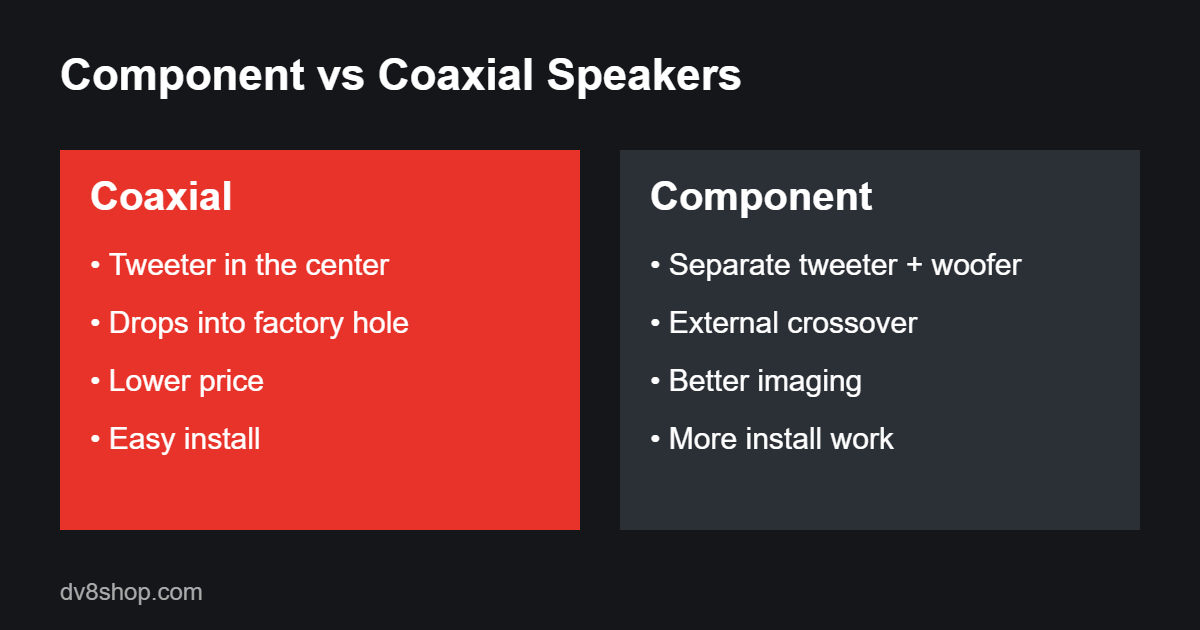
Component vs coaxial speakers explained: how each is built, how they sound, what installation takes, and which one to buy.
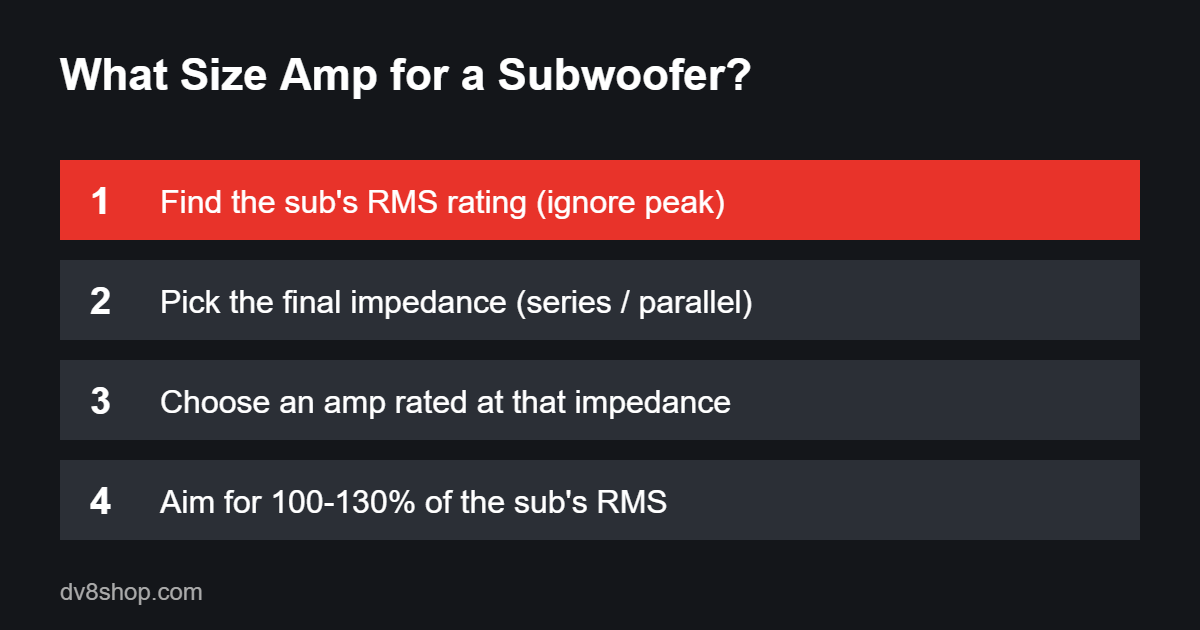
What size amp for a subwoofer? Learn how to match RMS power and impedance, with 4 easy examples and mistakes to avoid.