





Stetsom — The Brazilian Powerhouse Taking Car Audio to the Next Level
When it comes to car audio amplifiers that deliver massive power, rock-solid efficiency, and championship-grade reliability, few names turn heads quite like Stetsom. From…
19 categories
20 brands
DV8
17 products / 2 categories
SoundQubed
102 products / 6 categories
Beyma
29 products / 2 categories
Trinity
39 products / 3 categories
FI Car Audio
31 products
Every FI Car Audio product, together on one page.
Resilient Sounds
21 products / 2 categories
Stetsom
26 products
Every Stetsom product, together on one page.
Prodigy Audio
15 products / 2 categories
PRV Audio
189 products / 8 categories
Gately
50 products / 3 categories
Ruthless
17 products / 2 categories
Ill Customz
37 products / 2 categories
Limitless
17 products / 4 categories
BrandX
108 products / 5 categories
Galeforce
9 products / 2 categories
DS18
1,173 products / 15 categories
Nagy
11 products
Every Nagy product, together on one page.
Elite Sounds
7 products / 2 categories
Custom Speaker Pods
1,017 products / 4 categories
If you are looking to squeeze maximum output, unique acoustic response, and clean low-end thunder out of your subwoofer setup, stepping up to a 4th order enclosure (also called a 4th order bandpass enclosure) is one of the best moves you can make.
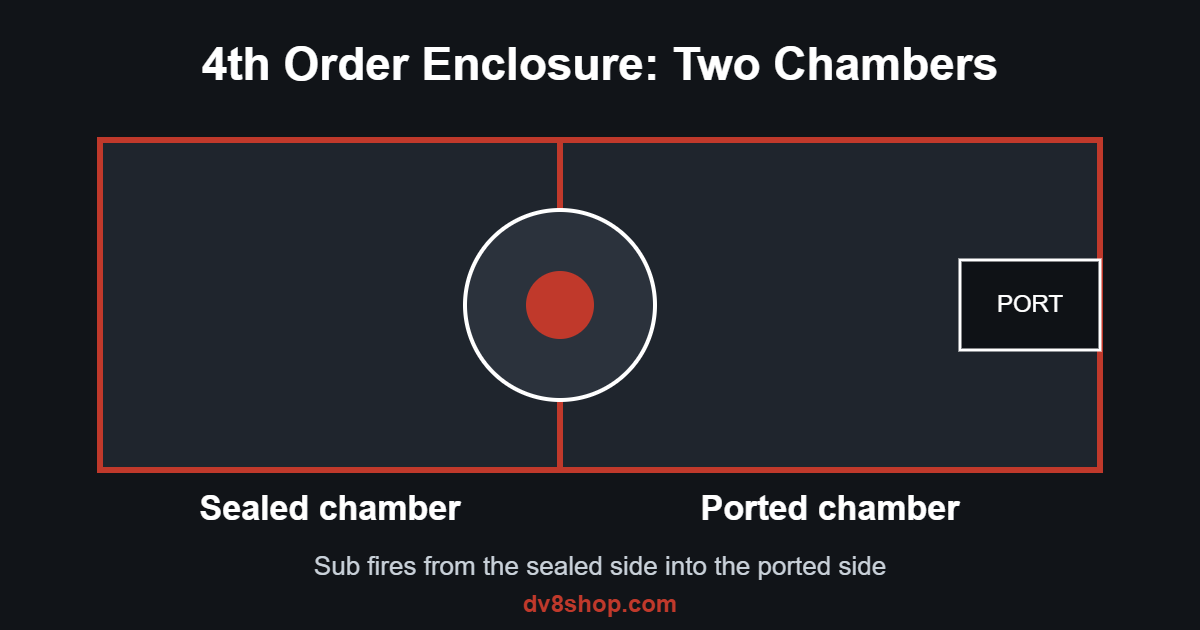
Unlike a standard sealed or ported box, a 4th order bandpass features a dual-chamber design: one chamber is sealed, and the other is ported. The subwoofer fires from the sealed chamber into the ported chamber, meaning all the sound you actually hear exits strictly through the port(s).
Building one correctly requires more precision than a traditional box. Here is a breakdown of how to approach designing a high-performance 4th order enclosure that performs.
Before cutting any wood, you need to make sure a 4th order enclosure fits your sonic goals and vehicle constraints. If you need a refresher on enclosure types, this overview is a good start.
You cannot just drop any random subwoofer into a 4th order enclosure and expect great results. Look for subwoofers with:
The magic of a 4th order lies entirely in the volume ratio between the Sealed Chamber and the Ported Chamber, as well as the tuning frequency of the ported side.
The port is the voice of your 4th order enclosure. Getting the port area and length wrong will choke the sub or create severe port noise (chuffing).
Because a 4th order enclosure has two distinct chambers experiencing high internal pressures and opposing forces, structural rigidity is non-negotiable.
Designing a 4th order enclosure takes patience, math, and precise carpentry, but the payoff is a custom-tailored sound profile that turns heads and rattles windshields. Take your time modeling the parameters, double-check your displacement calculations, and build it rock-solid.
When it comes to car audio amplifiers that deliver massive power, rock-solid efficiency, and championship-grade reliability, few names turn heads quite like Stetsom. From…
When bassheads demand big sound without the big price tag, Resilient Sounds steps up. Launched in 2014 near Cleveland, OH, this brand has quickly…
At Deviate Sound Solutions, we understand that the foundation of any great car audio system lies in reliable and high-quality components. That’s why we…