









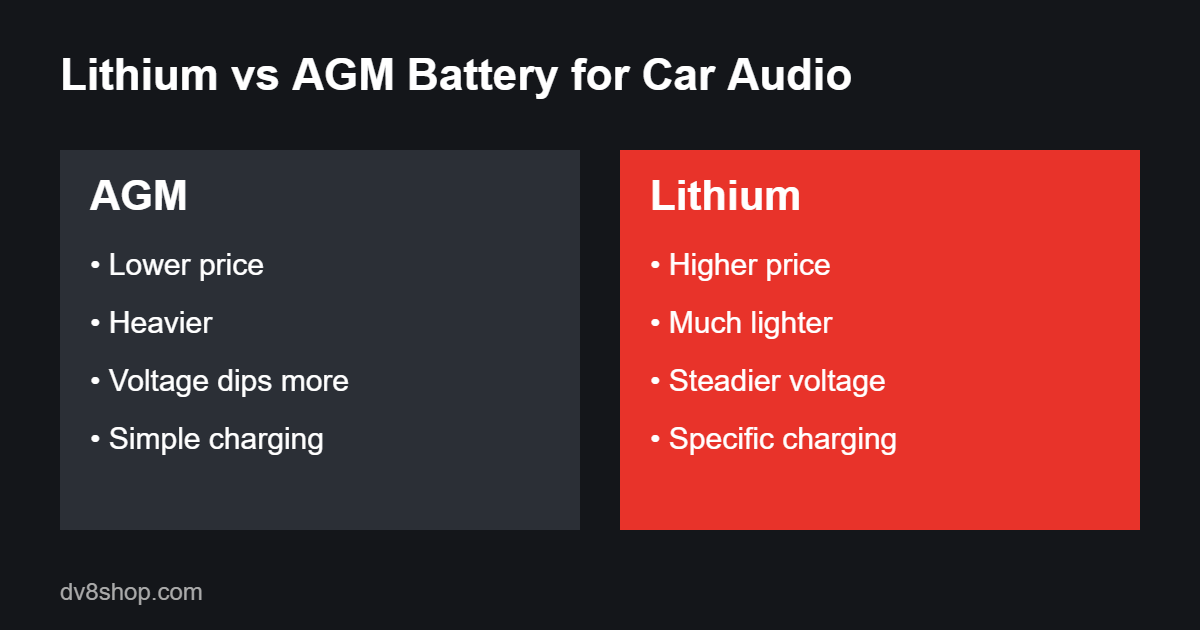
Lithium vs AGM Battery for Car Audio: Which One Should You Buy?
Lithium vs AGM battery for car audio: compare weight, voltage under load, lifespan and cost, and find out which one fits your system.
19 categories
20 brands
DV8
17 products / 2 categories
SoundQubed
125 products / 6 categories
Beyma
29 products / 2 categories
FI Car Audio
31 products
Every FI Car Audio product, together on one page.
Resilient Sounds
21 products / 2 categories
Stetsom
26 products
Every Stetsom product, together on one page.
Prodigy Audio
15 products / 2 categories
PRV Audio
189 products / 8 categories
Gately
50 products / 3 categories
Ruthless
17 products / 2 categories
Ill Customz
37 products / 2 categories
Limitless
17 products / 4 categories
BrandX
108 products / 5 categories
Galeforce
9 products / 2 categories
DS18
1,173 products / 15 categories
Nagy
11 products
Every Nagy product, together on one page.
Elite Sounds
7 products / 2 categories
Custom Speaker Pods
998 products / 4 categories
Voodoo Bikeworks
61 products / 9 categories
Alternator whine is that high-pitched noise that rises and falls with your engine speed, and it ruins an otherwise good car audio system.
The alternator makes electrical noise as it charges the battery. Most of the time that noise stays in the power system. When it sneaks into your audio signal, the speakers play it as a whine.
The usual cause is a ground problem or a signal cable picking up noise. You can read more about the classic cause in this overview of a ground loop.
Rev the engine with the stereo on and no music playing. If the pitch goes up with the revs, it’s alternator whine. If it stays steady no matter the engine speed, you’re probably chasing a different noise.
Next, switch the head unit to a source with no signal. If the whine disappears, the noise is coming in through the source. If it stays, it’s probably coming from your amps or wiring.
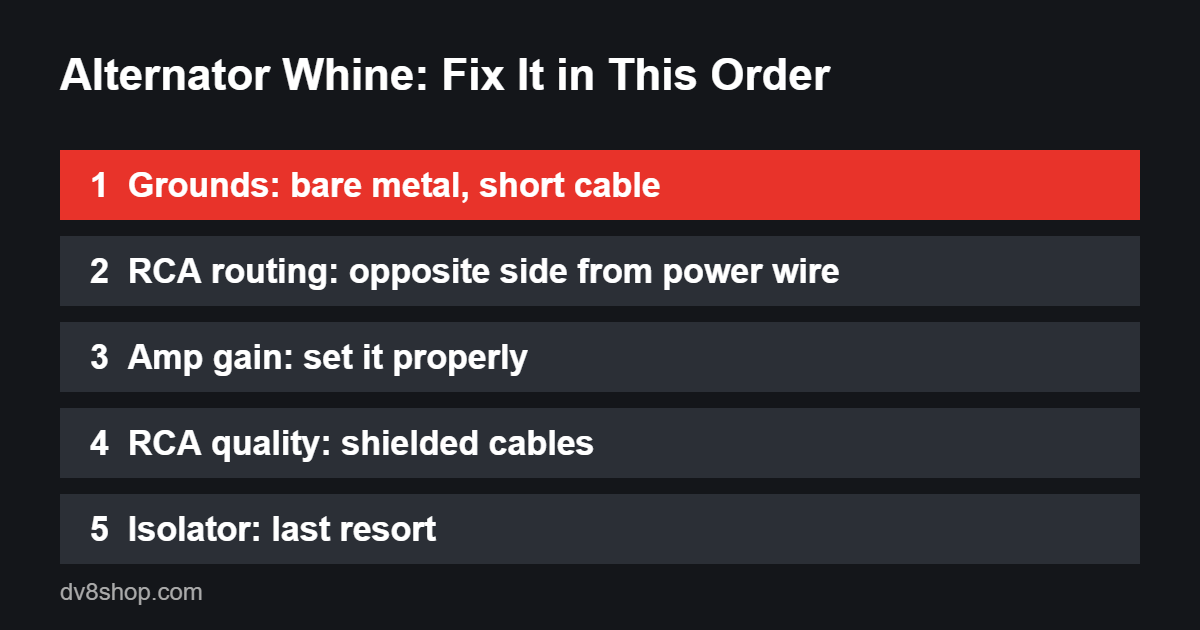
| Step | What to check | Why |
|---|---|---|
| 1 | Amp and head unit grounds | Bad grounds are the most common cause |
| 2 | RCA cable routing | Signal cables pick up noise from power wire |
| 3 | Amp gain setting | High gain boosts noise along with music |
| 4 | RCA cable quality | Poorly shielded cables let noise in |
| 5 | Ground loop isolator | Last resort for stubborn noise |
Every ground should go to bare, clean metal on the chassis, with a short cable. Sand off paint and rust, then bolt it down tight. If you have more than one amp, ground them at the same area when you can.
If your head unit shares a ground with something noisy, move it. A weak ground can turn the engine’s electrical noise into whine. A solid electrical system helps too, which is why our guide on the big 3 upgrade is worth a look.
Run power wire down one side of the car and RCA cables down the other. When they have to cross, cross them at a right angle. Running them side by side lets noise jump from the power wire into the signal cable.
Good shielded RCA cables help a lot. Cheap ones are the second most common source of whine after bad grounds.
If gains are cranked up, the amp boosts the noise along with the music. Set them properly and the whine often drops. The same gentle approach applies to a new sub, which we cover in our post on subwoofer break in.
The first mistake is jumping straight to a noise filter. Filters can hide a problem and often reduce sound quality. The next is replacing the alternator before checking the grounds. A new alternator rarely fixes a wiring issue.
Also, check that the RCA cables are fully seated. A loose plug can cause noise that looks a lot like whine.
Electrical noise from the alternator is getting into the audio path, usually from a bad ground or RCA cables near the power wire.
Sometimes. It’s best used after you’ve fixed the grounds and cable routing, since it can affect sound quality.
Yes, a failing alternator can make more noise, but check grounds and wiring first.
They can help if your current ones are poorly shielded. Routing matters just as much as quality.
For RCA cables, ground cable and wiring kits, browse dv8shop.com or send us a message.
Lithium vs AGM battery for car audio: compare weight, voltage under load, lifespan and cost, and find out which one fits your system.
Component vs coaxial speakers explained: how each is built, how they sound, what installation takes, and which one to buy.
What size amp for a subwoofer? Learn how to match RMS power and impedance, with 4 easy examples and mistakes to avoid.