



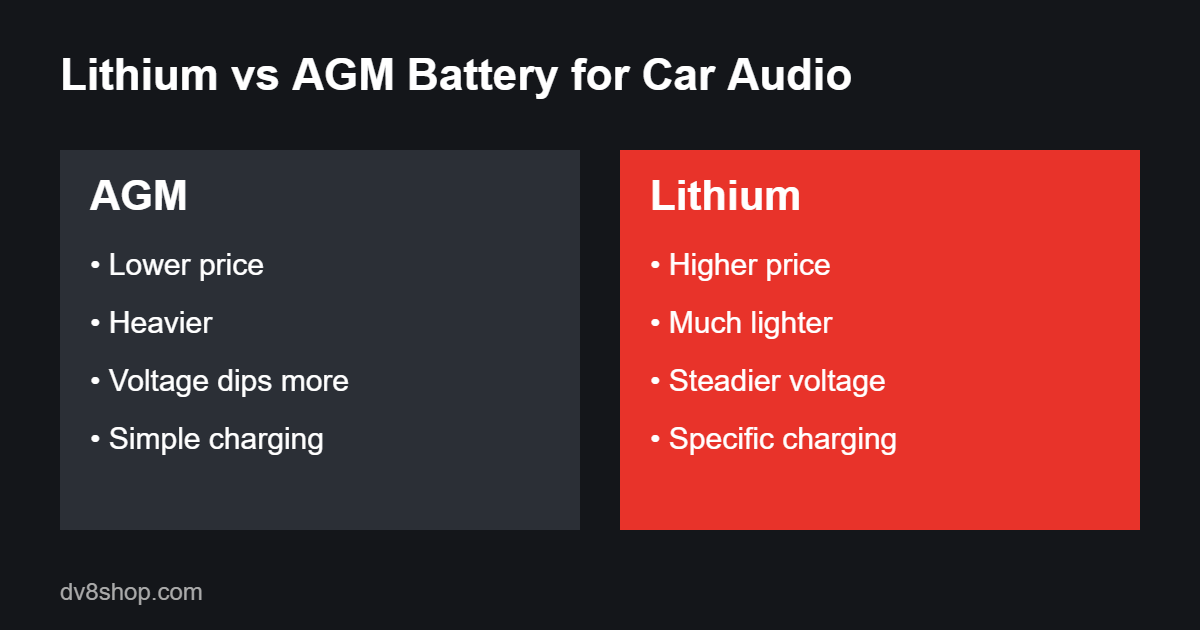
Lithium vs AGM Battery for Car Audio: Which One Should You Buy?
Lithium vs AGM battery for car audio: compare weight, voltage under load, lifespan and cost, and find out which one fits your system.
19 categories
20 brands
DV8
17 products / 2 categories
SoundQubed
125 products / 6 categories
Beyma
29 products / 2 categories
FI Car Audio
31 products
Every FI Car Audio product, together on one page.
Resilient Sounds
21 products / 2 categories
Stetsom
26 products
Every Stetsom product, together on one page.
Prodigy Audio
15 products / 2 categories
PRV Audio
189 products / 8 categories
Gately
50 products / 3 categories
Ruthless
17 products / 2 categories
Ill Customz
37 products / 2 categories
Limitless
17 products / 4 categories
BrandX
108 products / 5 categories
Galeforce
9 products / 2 categories
DS18
1,173 products / 15 categories
Nagy
11 products
Every Nagy product, together on one page.
Elite Sounds
7 products / 2 categories
Custom Speaker Pods
998 products / 4 categories
Voodoo Bikeworks
61 products / 9 categories

Understanding bandwidth starts here. In car audio aka the basshead community, Bandwidth is the span of frequencies your car audio system can play most efficiently.
Consult with your car audio technician on what the recommended bandwidth for your car audio build is as it can vary from system to system. Each build and bandwidth is unique however the general rule of thumb is plus or minus 10 frequencies of your enclosure tuning.
Generic Example:
Ported box tuned to 36 hz = Bandwidth 26-46hz
Understanding bandwidth matters. It is important to stay within your bandwidth not just for efficiency but also functionality. Playing your car audio system outside of its bandwidth can result in the malfunction of your car audio equipment. If you plan to compete in SPL Competition it is imperative you know your peak and bandwidth in order to choose songs and tones that will produce your peak DB level.
The signal bandwidth in hertz refers to the frequency range in which the signal’s spectral density (in W/Hz or V2/Hz) is nonzero or above a small threshold value. That definition is used in calculations of the lowest sampling rate that will satisfy the sampling theorem. The threshold value is often defined relative to the maximum value, and is most commonly the 3 dB point, that is the point where the spectral density is half its maximum value (or the spectral amplitude, in V or V/Hz, is 70.7% of its maximum).
The word bandwidth applies to signals as described above, but it could also apply to systems, for example filters or communication channels. To say that a system has a certain bandwidth means that the system can process signals of that bandwidth, or that the system reduces the bandwidth of a white noise input to that bandwidth.
The 3 dB bandwidth of an electronic filter or communication channel is the part of the system’s frequency response that lies within 3 dB of the response at its peak, which in the bandpass filter case is typically at or near its center frequency, and in the low-pass filter is near 0 hertz.
If the maximum gain is 0 dB, the 3 dB bandwidth is the frequency range where the gain is more than −3 dB, or the attenuation is less than 3 dB. This is also the range of frequencies where the amplitude gain is above 70.
7% of the maximum amplitude gain, and the power gain is above half the maximum power gain. This same half-power gain convention is also used in spectral width, and more generally for extent of functions as full width at half maximum (FWHM).

In electronic filter design, a filter specification may require that within the filter passband, the gain is nominally 0 dB ± a small number of dB, for example within the ±1 dB interval. In the stopband(s), the required attenuation in dB is above a certain level, for example >100 dB.
In a transition band the gain is not specified. In this case, the filter bandwidth corresponds to the passband width, which in this example is the 1 dB-bandwidth. If the filter shows amplitude ripple within the passband, the x dB point refers to the point where the gain is x dB below the nominal passband gain rather than x dB below the maximum gain.
Description content contains excerpts from WikiPedia Article: https://en.wikipedia.org/wiki/Bandwidth_(signal_processing) Creative Commons Attribution Share-Alike Attributions: https://en.wikipedia.org/w/index.php?title=Bandwidth_(signal_processing)&action=history
Bandwidth is the span of frequencies your system plays most efficiently. Understanding bandwidth helps you choose the right enclosure tuning and keep your subwoofer from playing where it is not built to.
Take your enclosure tuning frequency and go 10 Hz either way. A ported box tuned to 36 Hz has a bandwidth of about 26 to 46 Hz. Learn how tuning works in our sealed vs ported subwoofer box guide, or browse subwoofers and amplifiers at dv8shop.com.
Lithium vs AGM battery for car audio: compare weight, voltage under load, lifespan and cost, and find out which one fits your system.
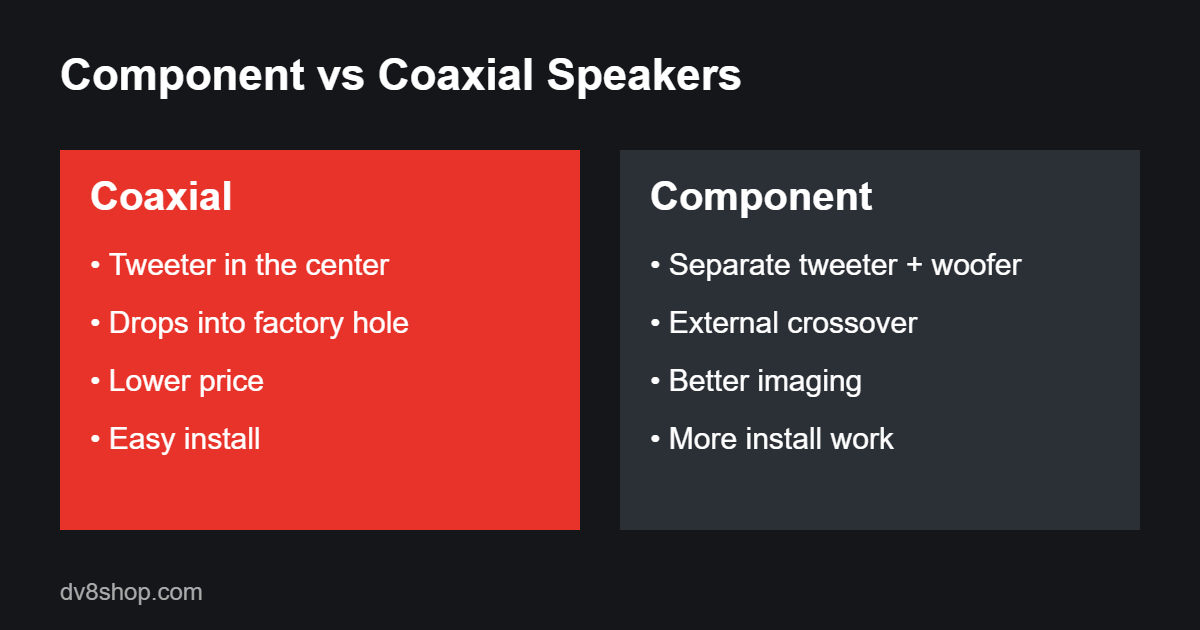
Component vs coaxial speakers explained: how each is built, how they sound, what installation takes, and which one to buy.
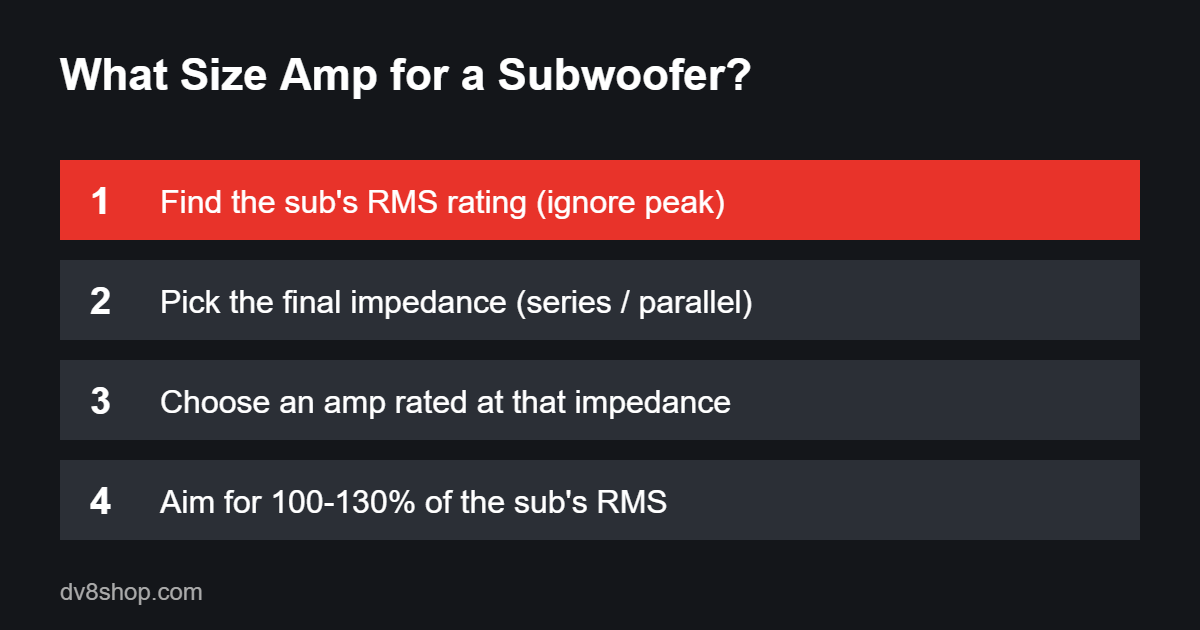
What size amp for a subwoofer? Learn how to match RMS power and impedance, with 4 easy examples and mistakes to avoid.