


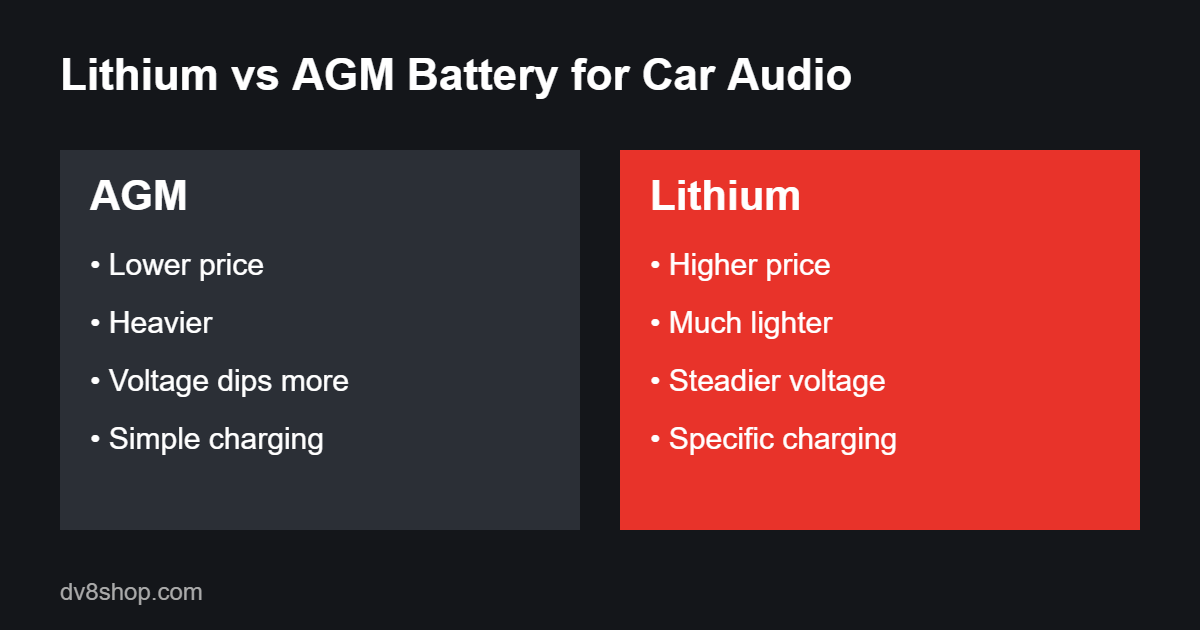
Lithium vs AGM Battery for Car Audio: Which One Should You Buy?
Lithium vs AGM battery for car audio: compare weight, voltage under load, lifespan and cost, and find out which one fits your system.
19 categories
20 brands
DV8
17 products / 2 categories
SoundQubed
125 products / 6 categories
Beyma
29 products / 2 categories
FI Car Audio
31 products
Every FI Car Audio product, together on one page.
Resilient Sounds
21 products / 2 categories
Stetsom
26 products
Every Stetsom product, together on one page.
Prodigy Audio
15 products / 2 categories
PRV Audio
189 products / 8 categories
Gately
50 products / 3 categories
Ruthless
17 products / 2 categories
Ill Customz
37 products / 2 categories
Limitless
17 products / 4 categories
BrandX
108 products / 5 categories
Galeforce
9 products / 2 categories
DS18
1,173 products / 15 categories
Nagy
11 products
Every Nagy product, together on one page.
Elite Sounds
7 products / 2 categories
Custom Speaker Pods
998 products / 4 categories
Voodoo Bikeworks
61 products / 9 categories

Tweeters vs compression drivers is a question that comes up more than you’d think, mostly from people who saw a horn tweeter at a show and wondered if they need one.
A tweeter is a small speaker that plays the top of the music, roughly 2,000 Hz to 20,000 Hz. That’s cymbals, vocals, strings and all the little details that make a song sound open. A compression driver does the same job, but it pushes sound through a horn. The horn is what gives it huge efficiency and loudness.
Most cars run dome tweeters. Competition and loud street builds are where compression drivers show up.
A dome tweeter moves a tiny diaphragm directly into the air. It’s smooth, it’s forgiving, and it fits in a pillar, a sail panel or the dash. At normal listening volumes it sounds clean and detailed, which is why almost every component speaker set ships with one.
The tradeoff is that a small dome runs out of steam when you turn it up a lot. Push one hard with too little crossover protection and it will tell you by getting harsh, or by dying.
A compression driver squeezes the diaphragm’s output through a small throat into a horn. That’s how PA systems and concert speakers get loud without needing much power. In a car, it means a lot more output from the same amp.
The downsides are real, though. They’re bigger, they need a horn, and the sound can come across as aggressive if the install and tuning aren’t dialed in.
| Factor | Dome tweeter | Compression driver |
|---|---|---|
| Sound | Smooth and detailed | Loud, punchy, can be bright |
| Efficiency | Average | Very high |
| Size | Small, easy to place | Larger, needs a horn |
| Install | Pillars, dash, sail panels | Custom mounting |
| Best for | Daily driving and clean sound quality | Loud builds and competition |

If you listen at normal volumes and care about clarity, go with tweeters. That’s the right answer for most people. If you’re chasing volume, or you’re building for a competition, a compression driver gets you there with less power.
Whichever you choose, the crossover matters as much as the driver. Keep the tweeter above its rated crossover point and set the amp gain with a clean signal. Our guide on mid-range vs mid-bass speakers covers how the rest of the speaker lineup hands off to the highs.
Tweeters are easy. Mount them where you can aim them toward the listening seat, test the position before cutting anything, and keep the wiring neat. Compression drivers need more space, so plan the horn location and check clearance before you commit.
Not better, just different. Compression drivers are louder and more efficient. Tweeters are smoother and easier to live with in a daily driver.
Yes, but it takes extra space, a horn and careful tuning. Most factory-style installs don’t have room for one.
Yes. Both need a high-pass filter so low frequencies don’t damage them.
Typically about 2,000 Hz up to 20,000 Hz, depending on the model and crossover setting.
If you’re not sure which way to go, browse the speakers and components at dv8shop.com or message us and we’ll help you match a setup to your car.
Lithium vs AGM battery for car audio: compare weight, voltage under load, lifespan and cost, and find out which one fits your system.
Component vs coaxial speakers explained: how each is built, how they sound, what installation takes, and which one to buy.
What size amp for a subwoofer? Learn how to match RMS power and impedance, with 4 easy examples and mistakes to avoid.