








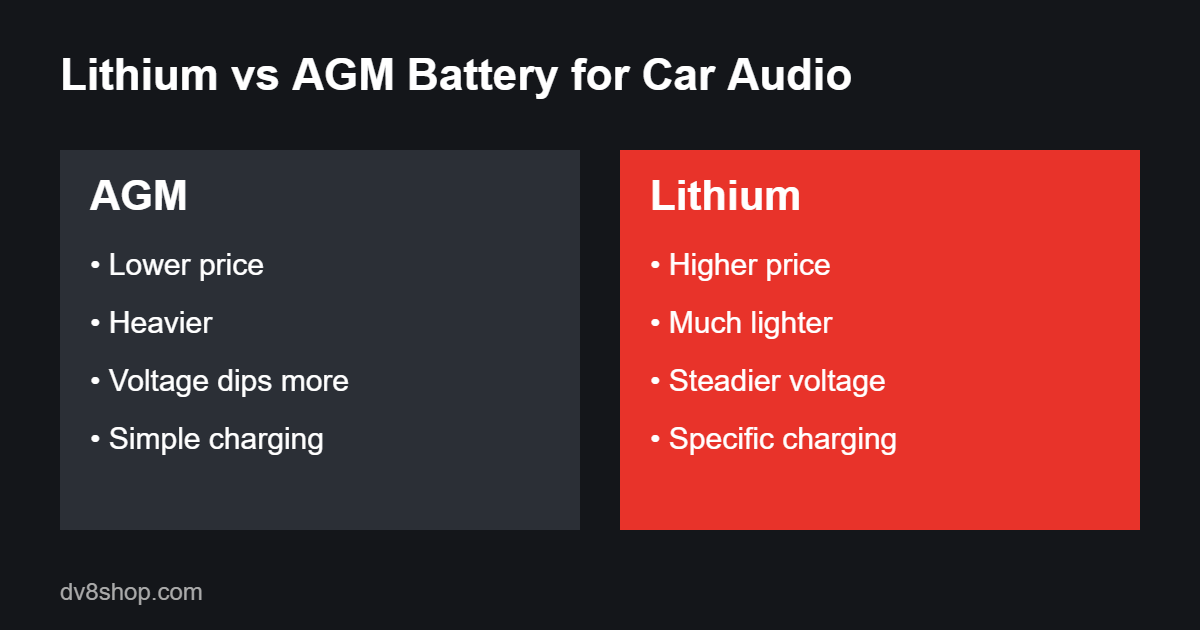
Lithium vs AGM Battery for Car Audio: Which One Should You Buy?
Lithium vs AGM battery for car audio: compare weight, voltage under load, lifespan and cost, and find out which one fits your system.
19 categories
20 brands
DV8
17 products / 2 categories
SoundQubed
125 products / 6 categories
Beyma
29 products / 2 categories
FI Car Audio
31 products
Every FI Car Audio product, together on one page.
Resilient Sounds
21 products / 2 categories
Stetsom
26 products
Every Stetsom product, together on one page.
Prodigy Audio
15 products / 2 categories
PRV Audio
189 products / 8 categories
Gately
50 products / 3 categories
Ruthless
17 products / 2 categories
Ill Customz
37 products / 2 categories
Limitless
17 products / 4 categories
BrandX
108 products / 5 categories
Galeforce
9 products / 2 categories
DS18
1,173 products / 15 categories
Nagy
11 products
Every Nagy product, together on one page.
Elite Sounds
7 products / 2 categories
Custom Speaker Pods
998 products / 4 categories
Voodoo Bikeworks
61 products / 9 categories
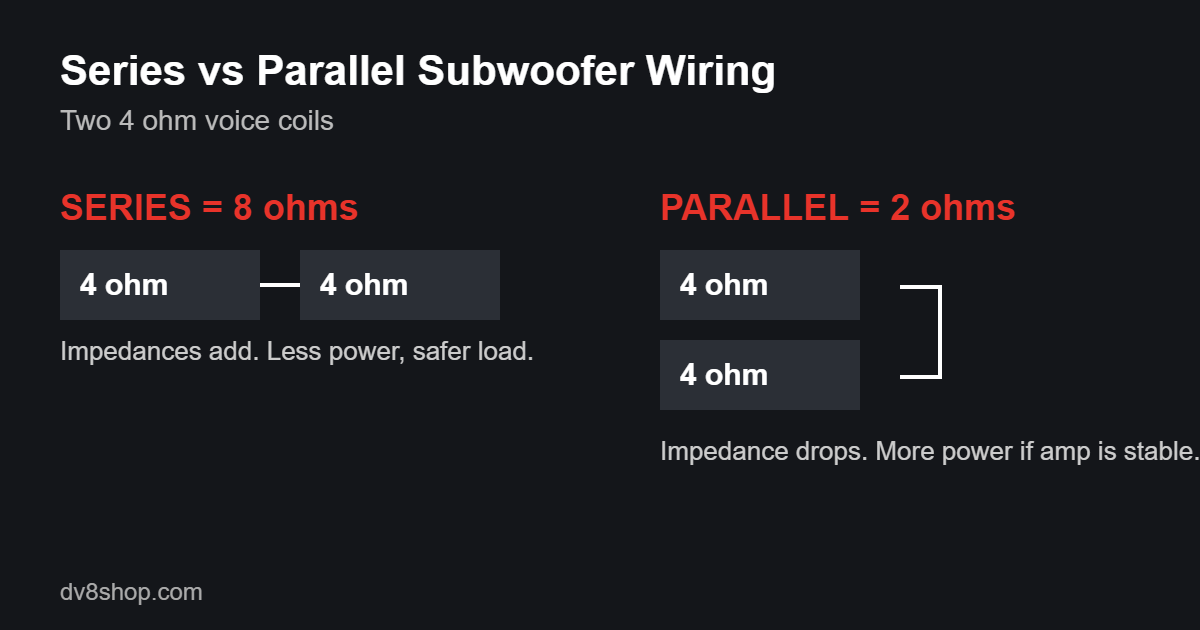
Series vs parallel subwoofer wiring comes down to one thing: the final impedance your amp sees.
Impedance is measured in ohms, and it’s basically how hard a speaker pushes back against your amp. Lower impedance lets the amp push more power, up to the amp’s limit. Higher impedance means less power and a cooler-running amp.
When you wire in series, the impedances add up. When you wire in parallel, the final number drops. That’s the whole idea. You can read the physics in this overview of series and parallel circuits.
In series, you connect the positive of the amp to the first coil, then the negative of that coil to the positive of the next, and so on. The last negative goes back to the amp. The impedances add together.
Two 4 ohm coils wired in series give you 8 ohms. It’s a safe choice, but you’ll get less power out of the amp.
In parallel, every positive connects together and every negative connects together. The final impedance drops. Two 4 ohm coils in parallel give you 2 ohms.
That lower number lets a stable amp put out more power. It also means your amp has to be rated for that load. If it isn’t, it can overheat or shut down.
| Setup | Series | Parallel |
|---|---|---|
| One dual 4 ohm sub | 8 ohms | 2 ohms |
| One dual 2 ohm sub | 4 ohms | 1 ohm |
| Two single 4 ohm subs | 8 ohms | 2 ohms |
| Two single 2 ohm subs | 4 ohms | 1 ohm |
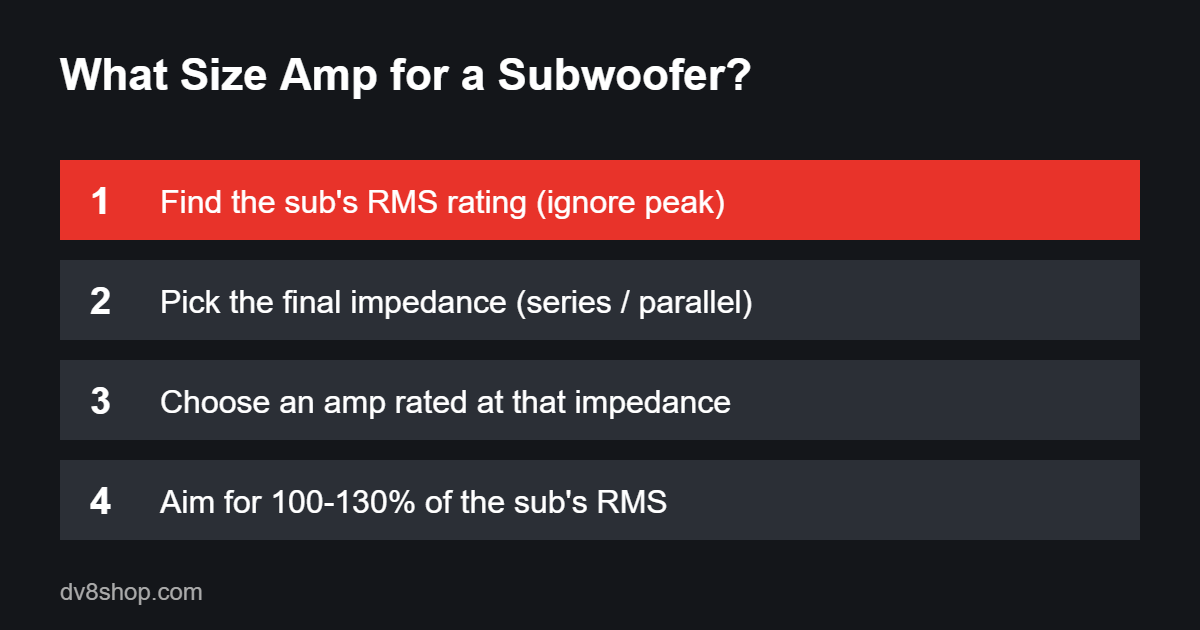
Start with your amp. Check the label or manual for the lowest impedance it’s rated to run. Then pick the wiring that lands on or just above that number.
If your amp is stable down to 2 ohms and your subs wire to 2 ohms, parallel gets you the most power. If your amp only likes 4 ohms or higher, series is the way. Matching the sub’s power rating to the amp matters just as much. Our post on car audio sound deadening is worth a read once your bass is wired up and you start hearing rattles.
The most common one is guessing. People wire to 1 ohm without checking whether the amp is 1 ohm stable, and then wonder why it keeps going into protect.
The next is mixing coil values. Don’t wire a 2 ohm sub and a 4 ohm sub together on the same channel. Also, loose or messy connections add resistance, so use clean crimps or solid terminals.
Neither is better in general. Parallel gives a lower impedance and more power if the amp supports it. Series gives a higher impedance and a safer load.
Indirectly. Wiring changes the impedance, which changes how much power the amp delivers. More power usually means louder, as long as the sub can handle it.
You shouldn’t. Use matching subs on the same channel so each one gets equal power.
Use a multimeter before connecting the amp. The reading will be a little lower than the rated number, which is normal.
If you want help matching a sub and amp so the wiring just works, browse dv8shop.com or message us with your setup.
Lithium vs AGM battery for car audio: compare weight, voltage under load, lifespan and cost, and find out which one fits your system.
Component vs coaxial speakers explained: how each is built, how they sound, what installation takes, and which one to buy.
What size amp for a subwoofer? Learn how to match RMS power and impedance, with 4 easy examples and mistakes to avoid.