


Car Audio Sound Deadening: Where to Start and What to Skip
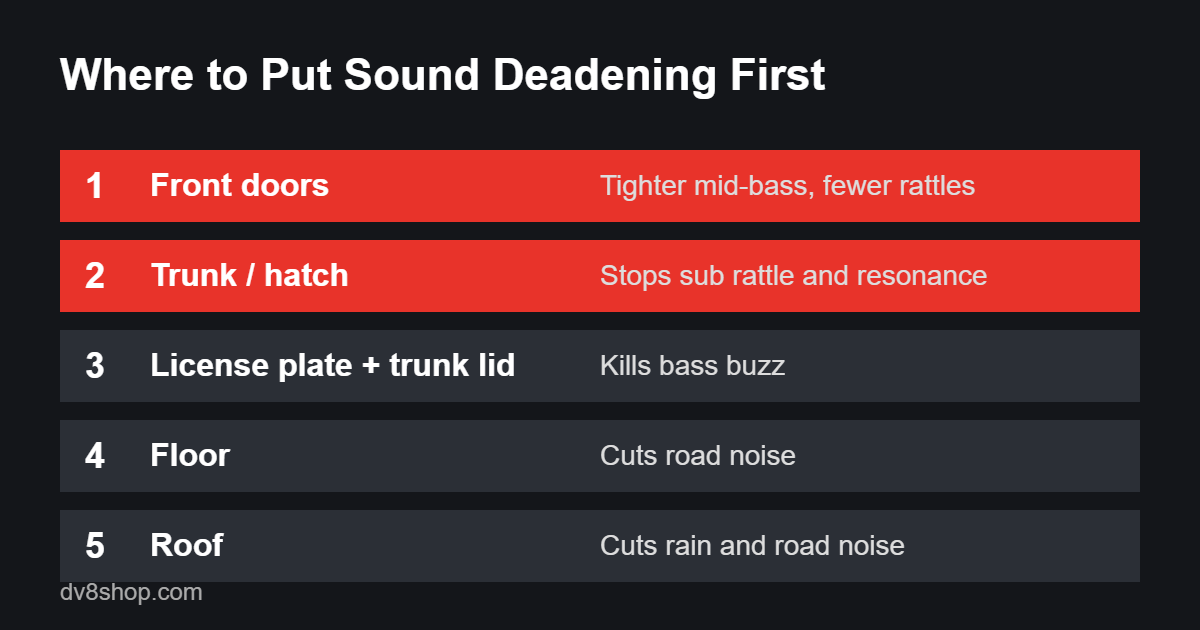
Car audio sound deadening explained: which panels matter most, how much material you really need, and 5 easy mistakes to avoid.
19 categories
20 brands
DV8
17 products / 2 categories
SoundQubed
102 products / 6 categories
Beyma
29 products / 2 categories
Trinity
39 products / 3 categories
FI Car Audio
31 products
Every FI Car Audio product, together on one page.
Resilient Sounds
21 products / 2 categories
Stetsom
26 products
Every Stetsom product, together on one page.
Prodigy Audio
15 products / 2 categories
PRV Audio
189 products / 8 categories
Gately
50 products / 3 categories
Ruthless
17 products / 2 categories
Ill Customz
37 products / 2 categories
Limitless
17 products / 4 categories
BrandX
108 products / 5 categories
Galeforce
9 products / 2 categories
DS18
1,173 products / 15 categories
Nagy
11 products
Every Nagy product, together on one page.
Elite Sounds
7 products / 2 categories
Custom Speaker Pods
1,017 products / 4 categories
Car speaker specs look like a wall of numbers: watts, ohms, decibels, hertz. You only need to understand four of them to avoid buying the wrong speakers, and none of them are hard once someone explains them straight.
Below are the four car speaker specs that matter, how to match speakers to your stereo or amp, and the numbers you can safely ignore.
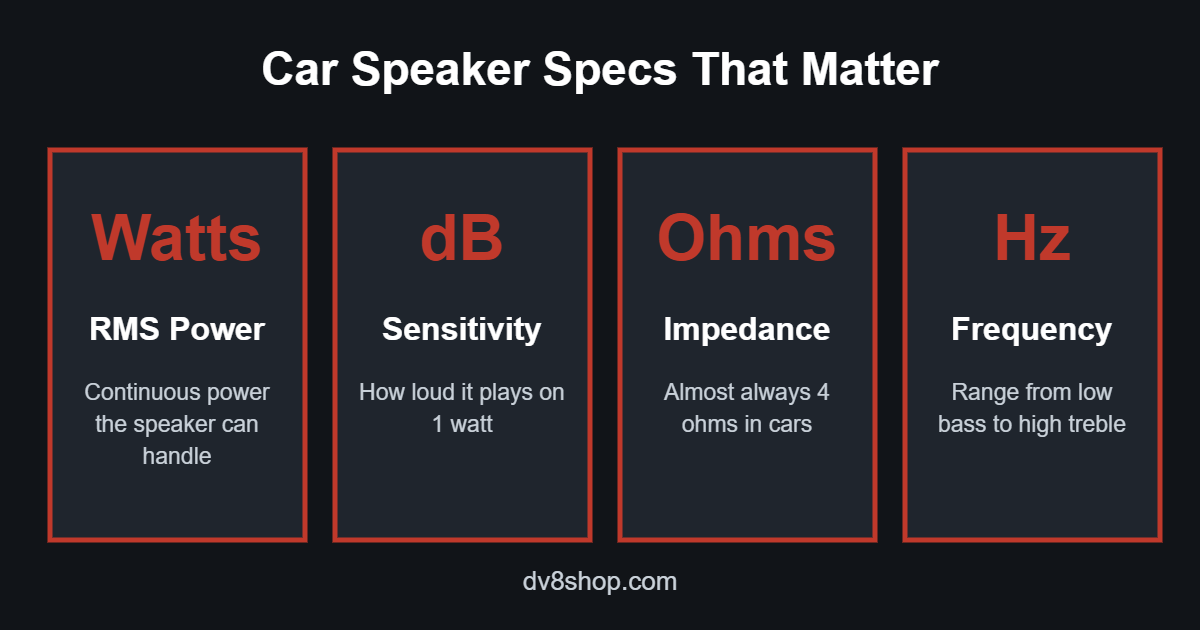
| Spec | What it means | What to look for |
|---|---|---|
| RMS power (watts) | How much power the speaker can handle continuously | Close to your amp’s RMS output per channel |
| Peak power (watts) | A short burst the speaker survives, mostly a marketing number | Ignore it when comparing |
| Sensitivity (dB) | How loud the speaker plays on 1 watt of power | 90 dB or higher for factory or low-power stereos |
| Impedance (ohms) | The electrical resistance the amp sees | 4 ohms for nearly all car speakers |
RMS is what a speaker can handle all day without damage. Peak power only describes a split-second burst, so a speaker listed at 300 watts peak might handle just 75 watts RMS. Skip the peak number and compare RMS.
Sensitivity tells you how efficient the speaker is. A speaker rated at 92 dB gets noticeably louder on the same power than one rated at 86 dB. If you’re running speakers off a factory or low-power stereo, this is the spec that matters most.
Impedance is measured in ohms, and almost every car speaker is 4 ohms. It only becomes a real question when you wire several speakers to one amp, because the wrong combination can overload the amp.
This is the range of sound the speaker can play, from low bass to high treble. A bigger range looks better on paper, but the numbers say little about how a speaker actually sounds. Of all the car speaker specs, this one tells you the least, so treat it as a rough guide, not a deciding factor.
Matching is simple when you follow three rules.
Also check the speaker size and mounting depth for your vehicle before you buy. The car speaker specs mean nothing if the speaker doesn’t fit your door.
No. Wattage only tells you how much power a speaker can take, not how good it sounds. Clean power matched to the speaker beats big numbers.
Usually, but check your amp’s manual. Many amps are rated for both 4 ohms and 2 ohms, and you should confirm before you wire anything.
Not always. High-sensitivity speakers can sound good on a factory stereo, but an amp gives them cleaner power and more volume.
It makes the speaker louder on the same power, which helps most when you run speakers without an amplifier.
Once you know these car speaker specs, comparing speakers gets a lot easier. You can browse speakers and amplifiers at dv8shop.com, or message us with your vehicle and we’ll help you match the right ones.
Car audio sound deadening explained: which panels matter most, how much material you really need, and 5 easy mistakes to avoid.
Sealed or ported sub box? Here's how each one sounds, how much space they need, and which fits your music, your car and your…
Not sure what size subwoofer to buy? Here's how 8, 10, 12 and 15 inch subs sound and which one fits your car, music…