




Car Audio Sound Deadening: Where to Start and What to Skip
Car audio sound deadening explained: which panels matter most, how much material you really need, and 5 easy mistakes to avoid.
19 categories
20 brands
DV8
17 products / 2 categories
SoundQubed
102 products / 6 categories
Beyma
29 products / 2 categories
Trinity
39 products / 3 categories
FI Car Audio
31 products
Every FI Car Audio product, together on one page.
Resilient Sounds
21 products / 2 categories
Stetsom
26 products
Every Stetsom product, together on one page.
Prodigy Audio
15 products / 2 categories
PRV Audio
189 products / 8 categories
Gately
50 products / 3 categories
Ruthless
17 products / 2 categories
Ill Customz
37 products / 2 categories
Limitless
17 products / 4 categories
BrandX
108 products / 5 categories
Galeforce
9 products / 2 categories
DS18
1,173 products / 15 categories
Nagy
11 products
Every Nagy product, together on one page.
Elite Sounds
7 products / 2 categories
Custom Speaker Pods
1,017 products / 4 categories
Choosing the right amp wire gauge is one of those steps people rush, and it’s where a lot of installs go wrong. Wire that’s too small for your amp heats up, drops voltage and starves the amp for current. You get less output, more clipping, and in the worst case a melted jacket behind a panel. The good news is it’s easy to get right. Here’s how we size wire at Deviate Sound Solutions.
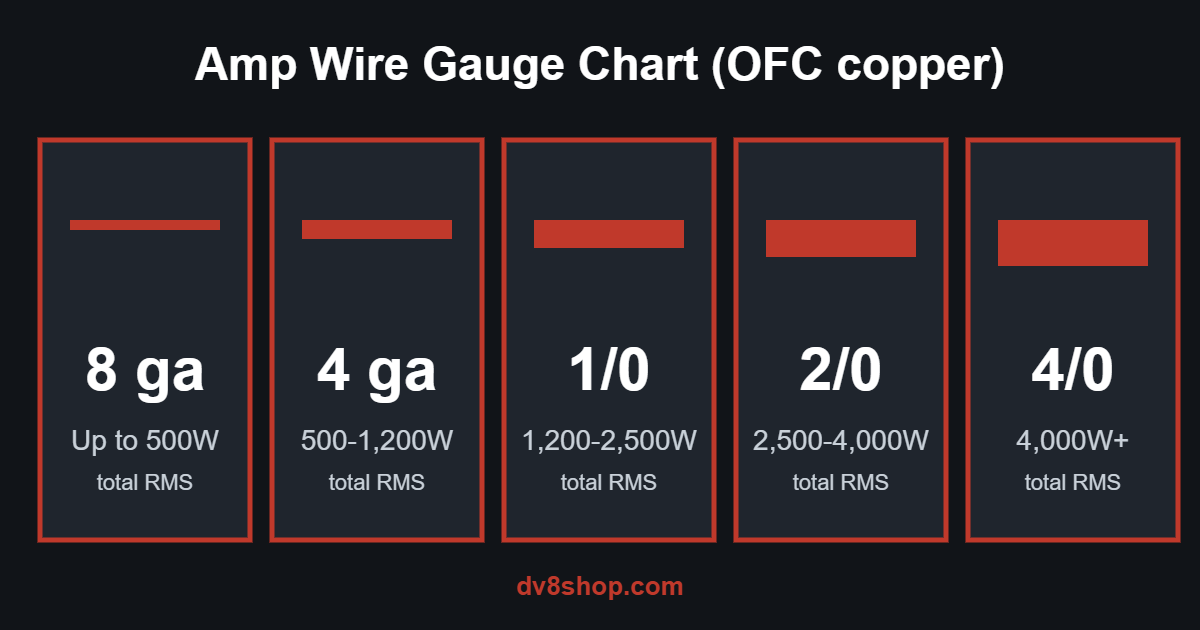
To pick your amp wire gauge, add up the RMS rating of every amp the wire will feed. Ignore “max” or “peak” numbers on the box, because RMS is what the amp actually pulls under real use. If you’re running two amps off one power run, add both together.
| Total RMS power | Recommended OFC gauge |
|---|---|
| Up to 500W | 8 gauge |
| 500W – 1,200W | 4 gauge |
| 1,200W – 2,500W | 1/0 gauge |
| 2,500W – 4,000W | 2/0 gauge (or dual 1/0) |
| 4,000W and up | 4/0 or multiple runs, plus an electrical upgrade |
Running longer than 20 feet, or mounting the amp in the back of a truck or SUV? Go up one amp wire gauge. When in doubt, bigger is never wrong. It only costs a little more.
OFC (oxygen-free copper) is solid copper all the way through. CCA (copper-clad aluminum) is aluminum with a thin copper coating. It’s lighter and cheaper, but it can’t carry as much current as the same size copper. If you go with CCA, step up one amp wire gauge from the chart above. For example, use CCA 4 gauge where OFC 8 gauge would do, or CCA 1/0 where OFC 4 gauge would do. For bigger systems we recommend OFC every time.
Your ground wire should be the same amp wire gauge as your power wire, kept as short as possible (under 18 inches is ideal) and bolted to bare metal on the chassis. Sand off paint first. A weak ground causes more amp problems than almost anything else.
Every power run needs a fuse within about 18 inches of the battery. That fuse protects the wire (and your vehicle) if the wire ever shorts, so size it to what the wire can safely carry. A waterproof ANL fuse holder with a ceramic ANL fuse is the standard setup for 4 gauge and larger.
Past roughly 1,500W RMS, a bigger amp wire gauge alone won’t fix dimming lights or voltage drop. Your alternator and factory cables become the bottleneck. That’s where a Big 3 upgrade, a second battery or a high-output alternator comes in. We cover that in Why You Need to Upgrade Your Electrical System Before Upgrading Your Car Audio.
If you’d rather not work out your amp wire gauge piece by piece, our amp kits come with 17ft of power wire, a ground wire, remote wire, a twisted RCA, pre-terminated ends, and a fuse holder with fuse: the 8 gauge OFC kit, 4 gauge OFC kit and 1/0 OFC kit. Or browse all our power and speaker wire, sold by the foot so you only pay for what you need.
A 1,000W RMS total falls in the 500W to 1,200W row of the chart, so 4 gauge OFC is the right amp wire gauge for a run up to about 20 feet. The sizes follow the American wire gauge system.
Not safely. 8 gauge is sized for up to about 500W RMS in our chart, so a 1,000W amp would be starved for current and the wire would run hot. Step up to 4 gauge.
Give us a call Monday through Saturday and tell us what amp you’re running and where it’s going. We’ll size it with you. Installers and shops can also ask about dealer accounts through DV8 Distribution.
Car audio sound deadening explained: which panels matter most, how much material you really need, and 5 easy mistakes to avoid.
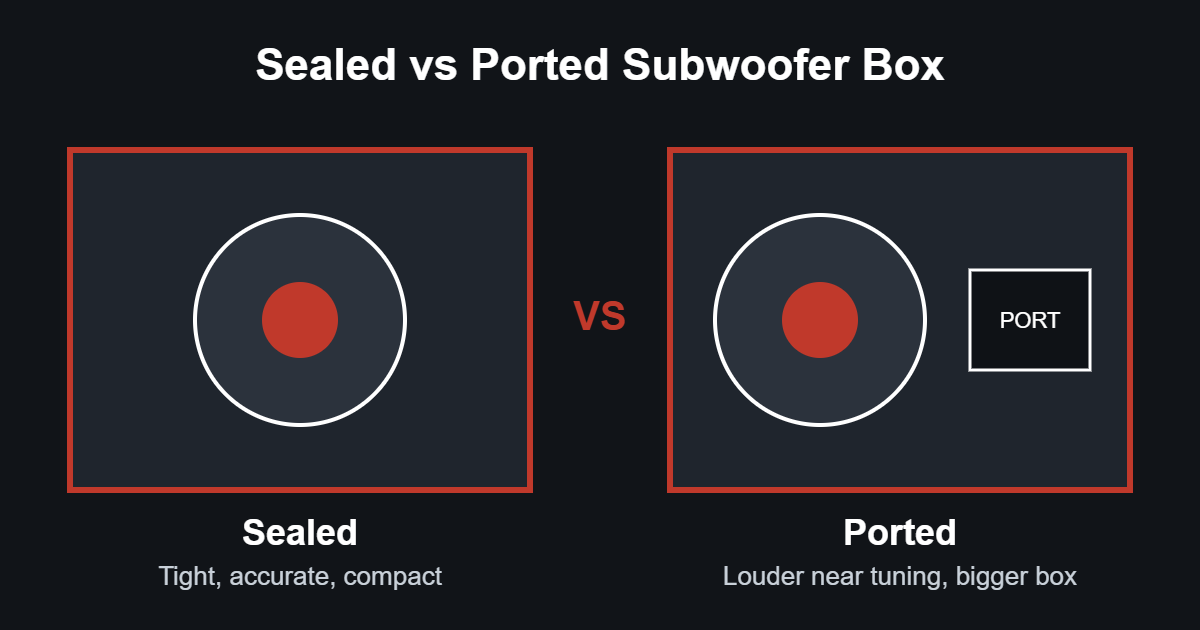
Sealed or ported sub box? Here's how each one sounds, how much space they need, and which fits your music, your car and your…
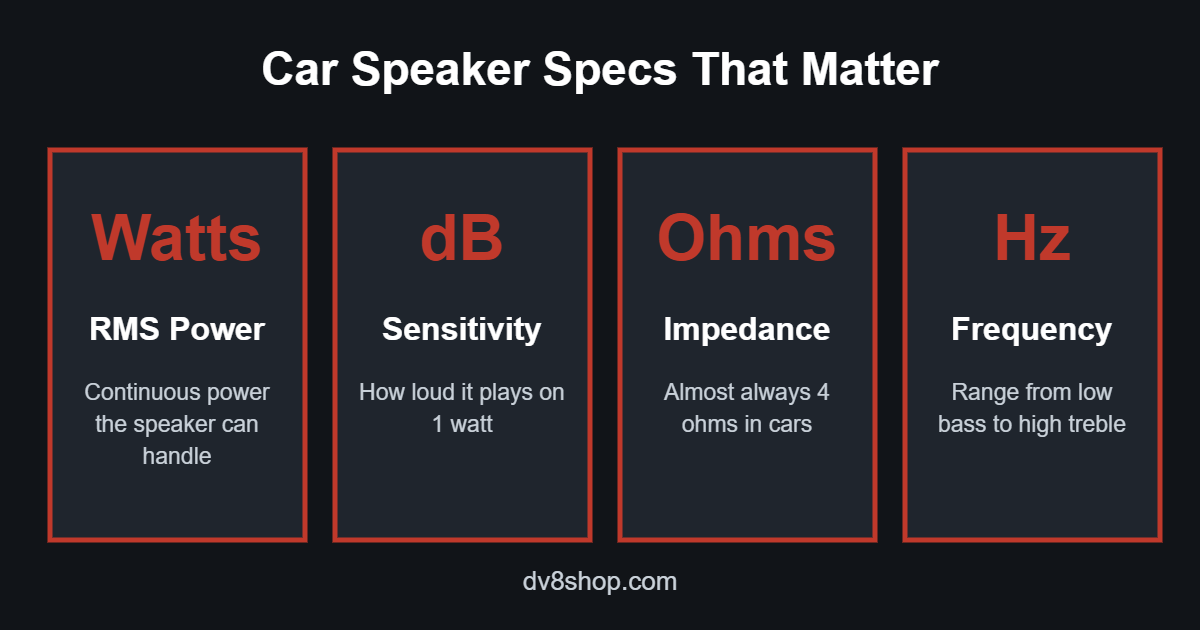
Confused by car speaker specs? Learn what RMS power, sensitivity and impedance mean and how to match speakers to your amp or stereo.